The Care Behind Everyday Sundanese Craft
Explore how makers describe material choices, practical skills, and design changes in Sundanese craft. These questions offer a careful way to learn from a particular maker without treating Bandung’s craft traditions as uniform.
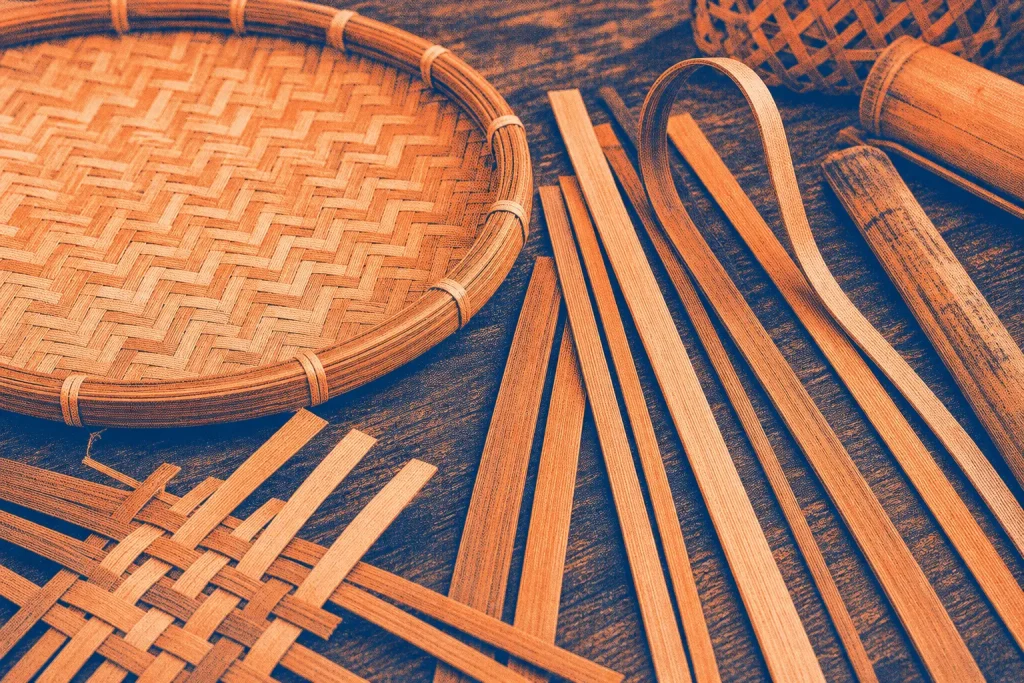
A woven bamboo tray sits beside narrow strips of prepared bamboo, each with a different width and bend. A maker might use the tray to explain a particular choice, but that account belongs to the maker and the object—not automatically to every Sundanese craft practice in Bandung.
Craft encounters can focus on materials, making techniques, or changes in design and use. These are useful ways to organize questions, not a complete map of Sundanese craft. Materials and methods vary between makers, objects, and settings, so a visitor should treat each explanation as specific. Asking what a maker is willing to share can reveal how an object was made without turning one person’s account into a claim about an entire tradition.
Ask how a maker selected and prepared the material
Start with the material visible in front of you. If a maker is working with bamboo, you might ask how they chose the pieces for this object and what preparation they used. A maker may be able to show differences between an unworked piece, a prepared strip, and a partly woven section. Those examples can help connect material choices to the object’s form.
Do not assume that one preparation method applies to all bamboo work, or that every maker uses the same source. Ask about the specific object: what was selected, what had to be done before shaping or weaving, and how the material’s condition affected the design. If the maker does not discuss a source or technique, accept that boundary rather than pressing for details.
If you are considering a purchase, ask how the object is intended to be used and what care the maker recommends. A maker’s answer can help you decide whether the piece suits your needs. For instance, if you want a tray for regular household use, ask whether the maker designed this particular piece for handling or display. Follow the maker’s guidance rather than assuming that objects made from similar materials need identical care.
Watch the sequence of a technique
A demonstration can make a sequence visible: how a maker handles a tool, positions material, or corrects a small error. These observations explain something a finished object alone cannot show. They do not, by themselves, establish how every practitioner learns or teaches the technique.
If you are considering a class, ask what participants will actually do, which tools and materials are supplied, and whether there is time for practice or questions. A short introduction may help you understand one part of a process; it need not be judged as a full course. If your aim is to try a movement and receive feedback, choose a session that explicitly includes hands-on practice and correction. If you mainly want to observe, a demonstration may fit better.
When watching someone work, avoid assuming that a movement has one correct form across all makers. You can ask what the maker is paying attention to in that moment, or how they decide whether a section is ready for the next stage. The answer may explain the maker’s own approach while leaving room for other approaches.
Discuss changes in design without assuming a single tradition
A maker may alter an object’s size, finish, material combination, or intended use. Ask what prompted that decision and which parts of the making process the maker chose to retain or change. The answer may describe practical needs, personal choices, or the expectations of a particular customer. It should be understood in that context, not taken as a general account of how Sundanese craft changes.
When comparing objects, look closely at what you can observe: the materials, construction, finish, and stated use. Then ask the maker how those choices relate to this piece. A newer design is not automatically a departure from tradition, and an object that resembles an older form does not, by appearance alone, tell you how its maker learned the technique.
There may be tradeoffs. A design intended for a different use may call for a different shape or finish, while the maker may have reasons to retain some features and alter others. Rather than deciding that a change is a loss or an improvement, ask what the maker wanted the object to do and what choices helped achieve that purpose.
Choose an encounter by the question you want answered
Choose a material-focused conversation if you want to understand how a maker selected and prepared material for a particular object. Choose a demonstration or class if you want to observe or try a technique. Ask about design changes if you want to learn why a maker adapted a form for a stated use. These categories can overlap, and the best fit depends on what the host offers.
Before you visit, clarify what will be available: a finished object, a demonstration, a conversation, or a chance to make something. Ask whether photography is welcome, and request permission before photographing a person, tools, or work in progress. Do not handle tools or unfinished pieces unless invited. These small courtesies let makers decide what they are comfortable sharing.
- Observation: The host can show an unworked material and a prepared piece. If you want to understand preparation, then ask how the maker made that particular change; otherwise, focus your questions on the finished object’s stated use.
- Observation: The host can explain where the material for the object came from. If the source is relevant to your question, then ask what the maker is willing to share; otherwise, ask how the material’s condition influenced this design.
- Observation: A session includes time for participants to handle material. If you want to try the technique, then ask what guidance is provided; otherwise, choose an observation-only format if available.
- Observation: The host describes the session as a brief introduction. If that matches your aim, then attend expecting to learn about one part of the process; otherwise, ask whether a longer lesson with practice is available.
- Observation: The maker identifies the object as intended for display rather than regular use. If you want a working household item, then ask about another design; otherwise, consider whether the display piece suits your purpose.
- Observation: The maker welcomes questions but does not invite photography. If you want to remember the process, then take written notes with permission; otherwise, listen without recording or photographing.
A hypothetical example of choosing between two visits
Hypothetical worked example: Imagine a visitor in Bandung has an afternoon, has never woven bamboo, and wants to learn how prepared strips are used. The visitor is choosing between a demonstration and a hands-on session. They ask both hosts whether the visit includes a view of prepared bamboo, whether questions are welcome, and whether visitors will handle material.
In this invented scenario, the demonstration includes prepared strips and time for the maker to explain their use, but no participant practice. The hands-on session offers a chance to try weaving, but the host says there will be little time to discuss preparation. The visitor’s stated priority is understanding how preparation relates to weaving, so they choose the demonstration. If the priority were instead to feel how a strip responds during weaving, the hands-on session would be the closer fit. The choice gives the visitor a focused encounter, not a complete account of bamboo work or Sundanese craft.
Let the maker’s account guide what you take away
A finished object cannot show every decision behind it. A conversation may reveal how a particular material was prepared; a demonstration may show a movement; a maker’s explanation may clarify why a design changed. Each is a partial view, and each is most useful when kept connected to the person and object being discussed.
When you encounter a crafted object in Bandung, ask one specific, respectful question about that piece: what did the maker need to consider before finishing it? Listen for the answer as an account of that maker’s choices, and let it guide what you notice next. That approach values skill without claiming that one object or conversation speaks for every Sundanese maker.
More city reading

Mengatur Dua Sesi Awal Guild
Menyambut anggota guild baru sering terlihat sederhana, padahal momen itu menentukan apakah mereka cepat merasa aman…
Evening Rhythm for Async Strategy
Coming back to an asynchronous strategy game after several months away can feel less like returning…