A Gentle Guide to Spending Time in a City Garden
Choose a comfortable corner, settle into a simple activity, and leave the garden ready for the next visitor. These calm habits suit Bandung’s public green spaces and other shared gardens.
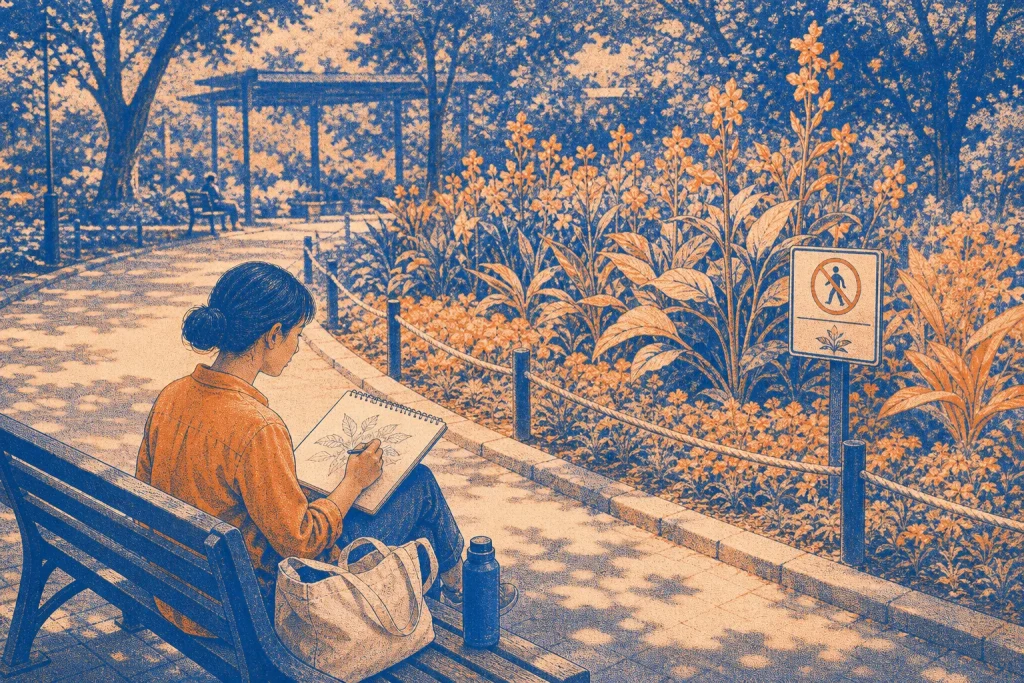
You arrive at a Bandung garden carrying a sketchbook, but the flowers that caught your eye sit behind a low rope. A nearby sign points visitors toward a marked path. That small choice—drawing from the path rather than stepping closer—lets you enjoy the garden while respecting the work that keeps it alive.
Plants, soil, shade and water features shape a garden as much as its benches do. A visit can be restful and attentive without treating the landscape as a backdrop to rearrange. Notice how the space is maintained, choose an activity that leaves plants undisturbed, and take away everything you brought.
Read the garden before choosing an activity
At the entrance, look for posted rules, temporary barriers and signs about maintenance. They may indicate which lawns are open, where food is permitted, or whether a path is closed. If a notice is unclear, keep to the open route and ask a staff member when one is available rather than guessing that a gap in a barrier is an invitation.
Then notice what the garden offers. A paved loop may suit a slow walk; a designated lawn may be appropriate for sitting if signs allow it; a planted border is for viewing, not a shortcut. The distinction matters because compacted soil and damaged stems can take attention away from the garden’s intended care.
Choose a purpose that fits the setting. Reading, writing a few observations, sketching from a seat, or taking a quiet walk all require little equipment and can be paused easily. For a nature-focused visit, observe leaf shapes, patterns of shade, or the sound of birds without touching nests, picking flowers, or feeding wildlife.
Bring tools that support a light-footed visit
A small notebook and pencil are enough for field notes or a quick drawing. A phone can photograph a leaf or canopy from the path, while a reusable bottle helps you avoid carrying loose drink containers. If you bring a snack, check the rules first and pack a bag for wrappers and crumbs.
Keep supplies together rather than spreading them across a bench or lawn. This is especially useful when a garden has narrow paths or limited seating. A tote or compact backpack can hold a notebook, pencil, bottle and any rubbish until you reach an appropriate bin or leave the garden.
For sketching, use a stable surface such as a bench or your own lap. Do not pin paper to a tree, rest a board against a plant, or collect leaves as references. A photograph or written description preserves the details without removing anything from the garden.
Observe plants without disturbing them
Look closely from an open path or a designated viewing area. Notice how a flower’s color changes in shade, where rainwater gathers, or which plants create a shaded edge. These observations can make a short visit feel purposeful without requiring access to restricted ground.
Stay out of planted beds even when the soil looks bare. Young plants may be difficult to see, and a bed can be awaiting new planting or maintenance. If a branch blocks a view, do not bend or trim it; choose another angle or draw the part of the scene you can see.
Keep wildlife at a respectful distance. Do not approach, touch, or feed animals unless the garden explicitly permits a particular activity. If an animal is near your path, wait for it to move away or take another open route. That choice avoids turning a quiet observation into a disturbance.
Use a simple field-note method
Brief notes can help you remember what you noticed without making the visit feel like a formal survey. Record the place you are standing, the visible feature, and one question or impression. For example, you might write, “From the paved path: broad leaves make a patch of shade; why does the soil look darker here?” Keep the note descriptive rather than claiming to identify a plant unless you are sure.
If you take photographs, frame plants and landscape features without blocking a path. Avoid stepping over ropes for a closer view. When another visitor is prominently visible in a close shot, ask before taking or sharing the image; a garden’s public setting does not make every person a willing subject.
Sound can be part of observation, too. Pause to listen for leaves moving or water running, but keep calls brief and audio on headphones rather than playing it aloud. If your activity requires more concentration than the setting allows, pause, relocate to another permitted spot, or choose a different activity.
Work through a hypothetical garden visit
Imagine a visitor arrives at a Bandung garden with a notebook, pencil and water bottle. For this hypothetical example, the starting point is a marked path beside a flower bed, with a sign saying the bed is closed to visitors and an open bench nearby. The visitor wants to sketch one plant without touching it.
-
They read the sign and decide not to enter the bed. The observable result is a clear boundary between the path and the planted area, so the drawing will be made from outside it.
-
They sit on the open bench and set the notebook on their lap, keeping the bottle and bag beside their feet. The bench remains usable, and the supplies do not spread into the path.
-
They draw the visible leaf shapes and note that the flowers are partly hidden from this angle. They do not move the plants; the tradeoff is a less complete view in exchange for leaving the bed undisturbed.
-
A group arrives and begins using the nearby seating area. The visitor closes the notebook and walks along the marked path to another open place, or ends the sketch if no suitable spot is available. Either choice avoids treating the bench as reserved.
-
Before leaving, they check the seat and ground for the pencil, bottle and any rubbish, then follow the open path to the exit. The result is a finished sketch and a clean departure without taking anything from the garden.
Leave the garden ready for its next use
Before you go, check the ground, bench and the space around your feet for small items such as a pencil cap, tissue or food wrapper. Put rubbish in an appropriate bin or carry it out if none is available. Do not sweep crumbs into soil or leave food for animals.
Return movable furniture only if visitors are allowed to move it, and do not try to repair a damaged fixture yourself. If you notice a hazard or a broken feature, tell staff or use the garden’s designated contact route. Follow closing notices and staff directions, particularly if maintenance has changed which areas are open.
A garden visit can leave you with a page of notes, a sketch, or simply a clearer memory of the place. The useful habit is to observe closely while leaving the plants, paths and facilities as you found them; when access is limited, a view from the path is still a view worth keeping.
More city reading

Mengatur Dua Sesi Awal Guild
Menyambut anggota guild baru sering terlihat sederhana, padahal momen itu menentukan apakah mereka cepat merasa aman…
Evening Rhythm for Async Strategy
Coming back to an asynchronous strategy game after several months away can feel less like returning…